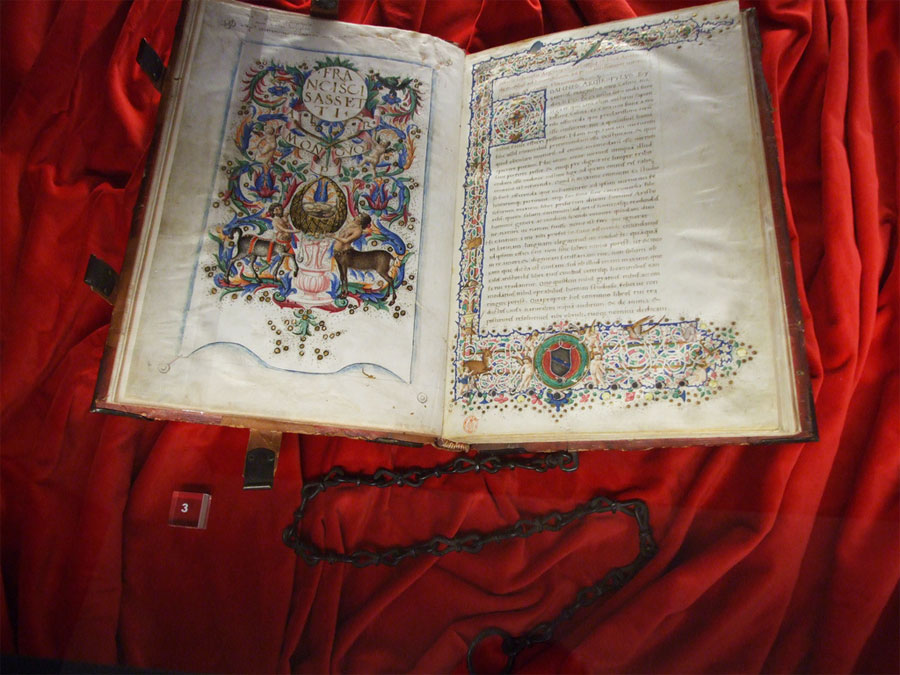
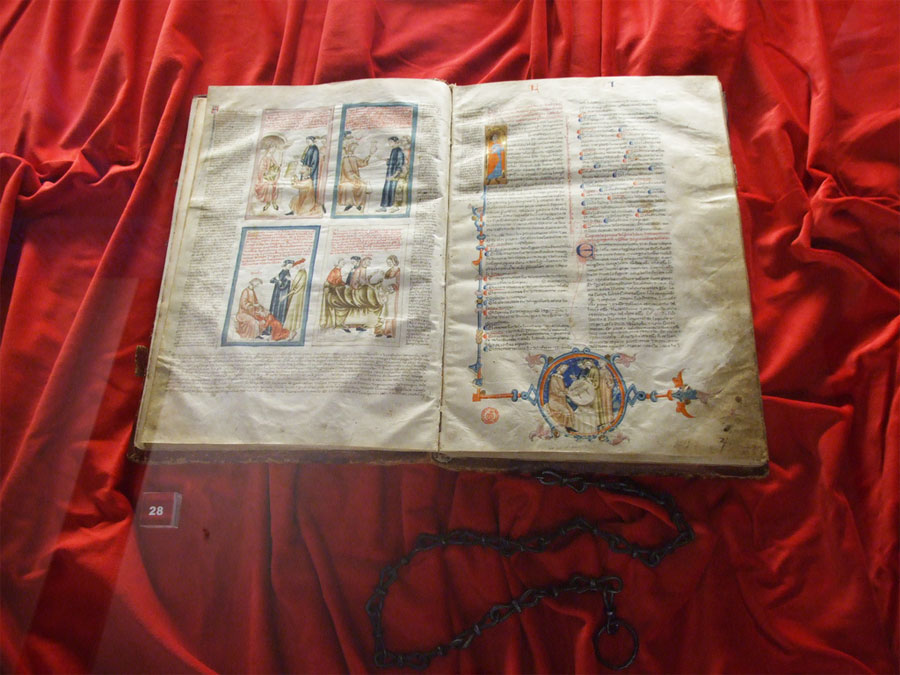
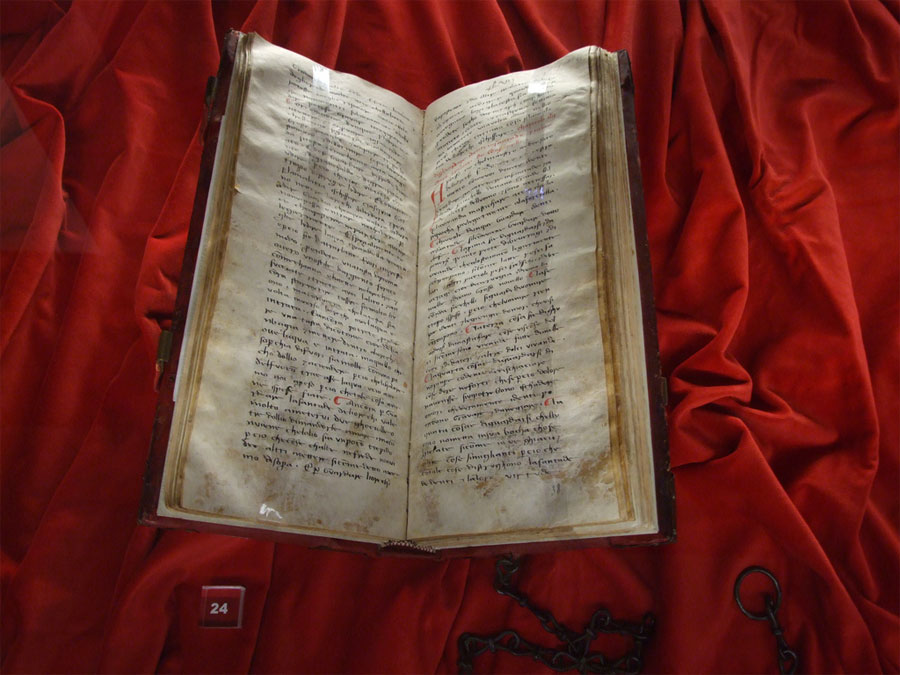
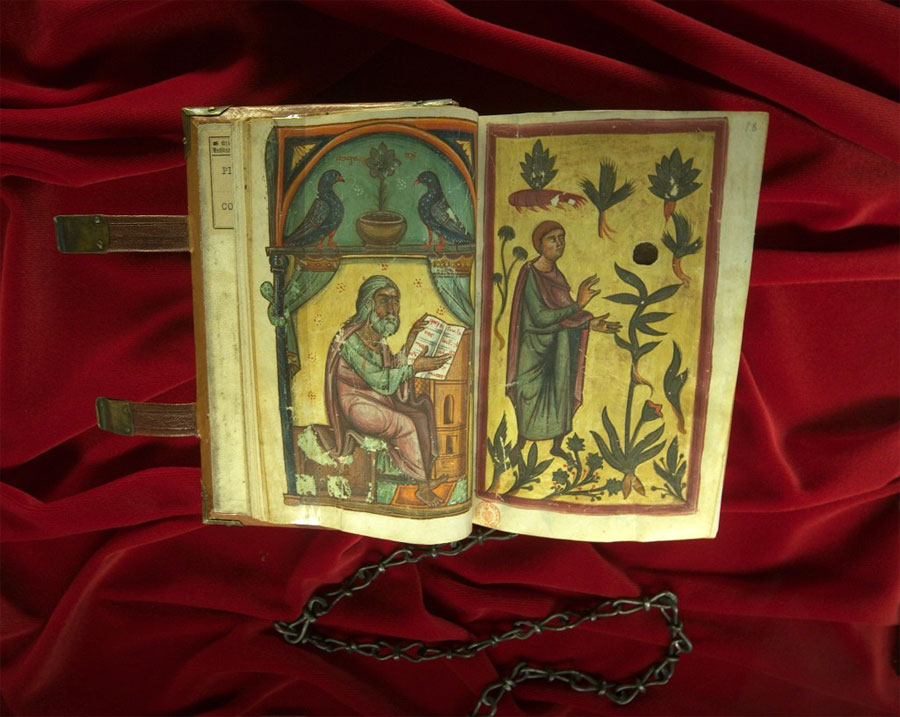
On the first floor of the Brunelleschi cloister is
the entrance to the Laurentian Library which houses
what must be considered the most important and prestigious
collection of antique books in Italy. It comprises
the most lasting cultural inheritance which the Medici
family has passed down to the attention, care and
admiration of posterity. The collection had its genesis
in the humanistic interests of Cosimo the Elder and
his attendance of the Academy of Roberto de' Rossi.
There followed his friendship with Niccoló Niccoli
with whom he shared a passion for collecting ancient
manuscripts of the works of classical authors. With
Niccoli's guidance Cosimo acquired a great number
of these. At the former's death, in 1437, Cosimo inherited
most of Niccoli's library and donated a great many
of these manuscripts to the monastery of San Marco.
He also founded the library at the "Badia Fiesolana".
He was assisted in his acquisitions for this collection
by Vespasiano da Bisticci who provided copysts with
classical texts for subsequent diffusion. The original
nucleus of volumes was then added to by Cosimo's son
Piero. Subsequentely Lorenzo completed the collection
with the acquisition of, above all, Greek texts.
The library followed the ups and downs of the Medici
family. In 1494, following the sentence of exile
imposed of Piero the Unfortunate and the banishment from Florence
of the whole of the Medici family, the library was
confiscated by the republican government and absorbed
in toto into the library of the San Marco monastery.
In 1508 it was recDowned by Cardinal Giovanni de'
Medici (the second son of Lorenzo the Magnificent,
he became Pope Leo X) who transferred it to Rome.
His successor Clement VII (Giulio de' Medici, son
of Giuliano di Piero) brought the collection back
to Florence in 1523 and immediately commissioned
Michelangelo to design a library to house it.
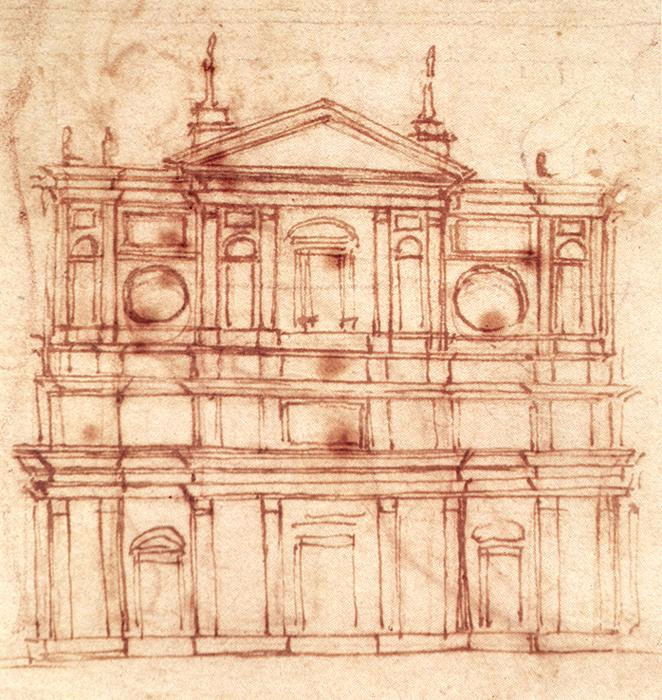
This was to be another very important project for
Michelangelo, because he made preparatory drawings
for it and concerned himself with its construction
for ten years before his definitive departure for
Rome in 1534. However, he did not relinquish control
of the project, monitoring the phases of building
as the work was continued by his followers Giorgio
Vasari and Bartolommeo Ammannati, who also completed
Michelangelo's New Sacristy and who were assiduous
in following the master's plan.
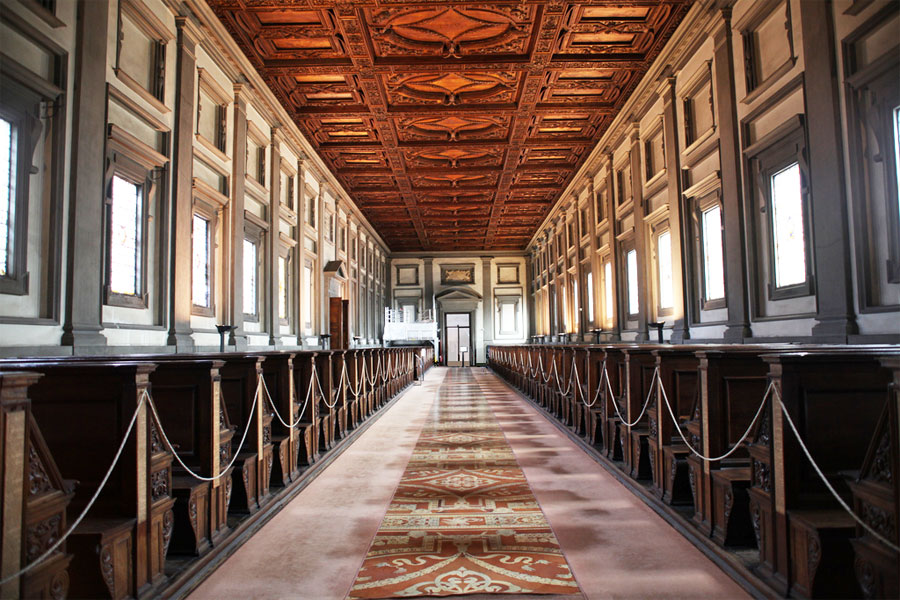
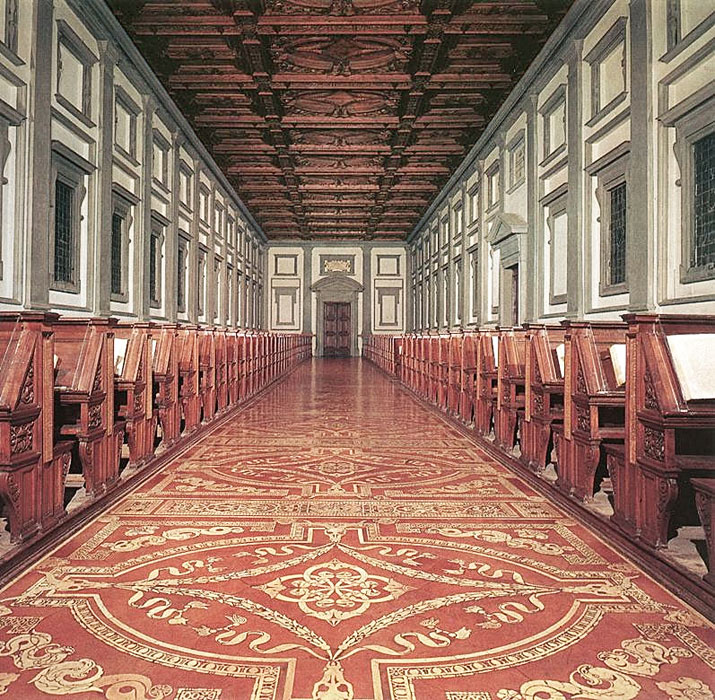
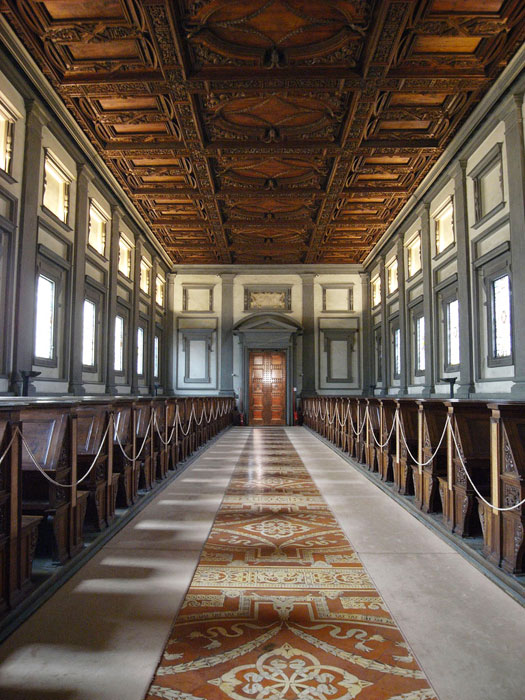
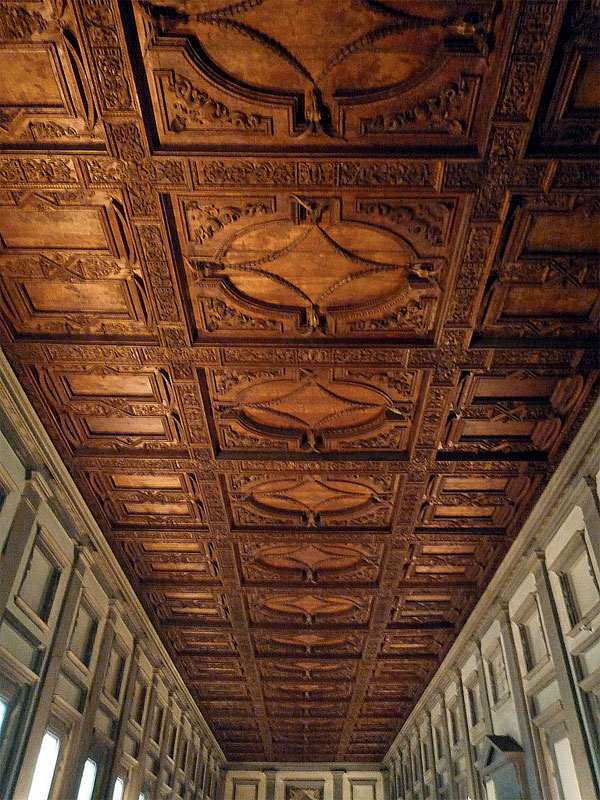
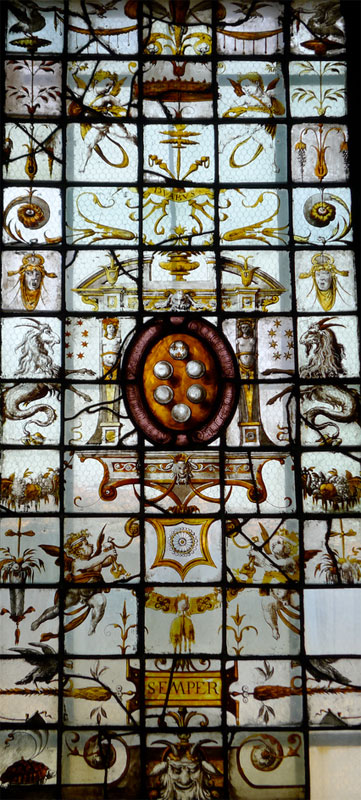
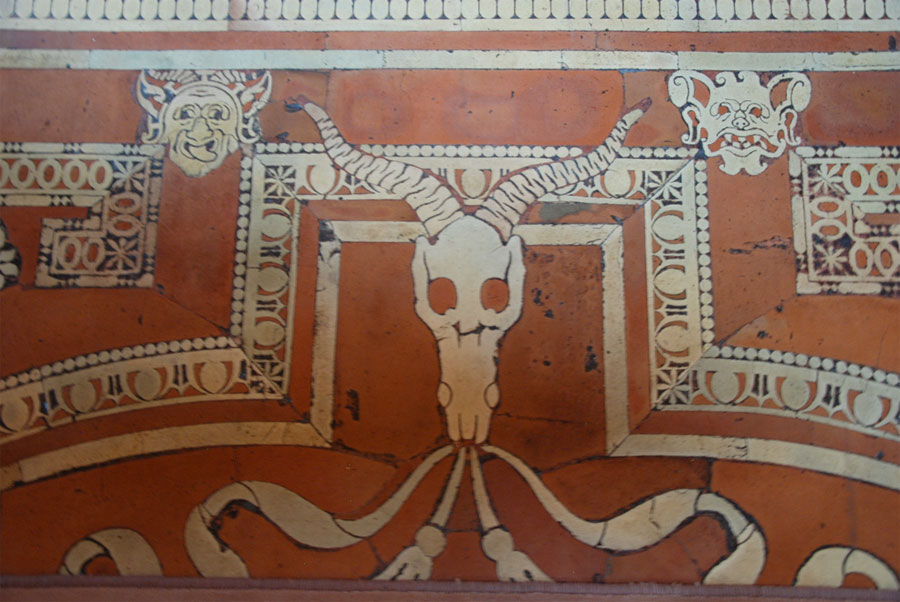
The decoration of the library went hand in hand with
its actual construction (the ceiling dates to 1549-1550,
the flooring from 1549-1554, the windows from 1558-1568)
thus making the library one of the most unified
works of the High Renaissance (or should we say
of Mannerism) to be found in Florence. The vast
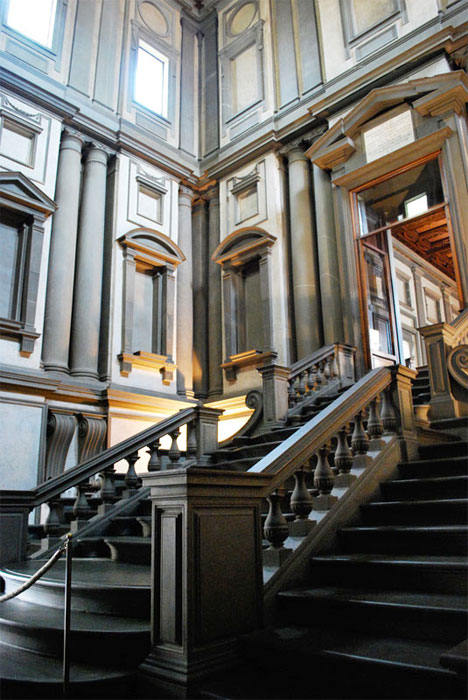
reading-room is preceded by the dramatic entrance
vestibule (called the "ricetto") planned in elevation
by Michelangelo and built in that characteristic
Florentine two-one combination of grey sand-stone
elements on white plaster. Here Michelangelo's energetic
and powerfully modelled architectural vocabulary
(free from the constraints of the Brunelleschian
style imposed on him, to a certain extent, in the
New Sacristy) emerges in the tabernacle niches,
the paired columns, the portal, all imbued with
a feeling of solid strength. This dynamism, concentrated
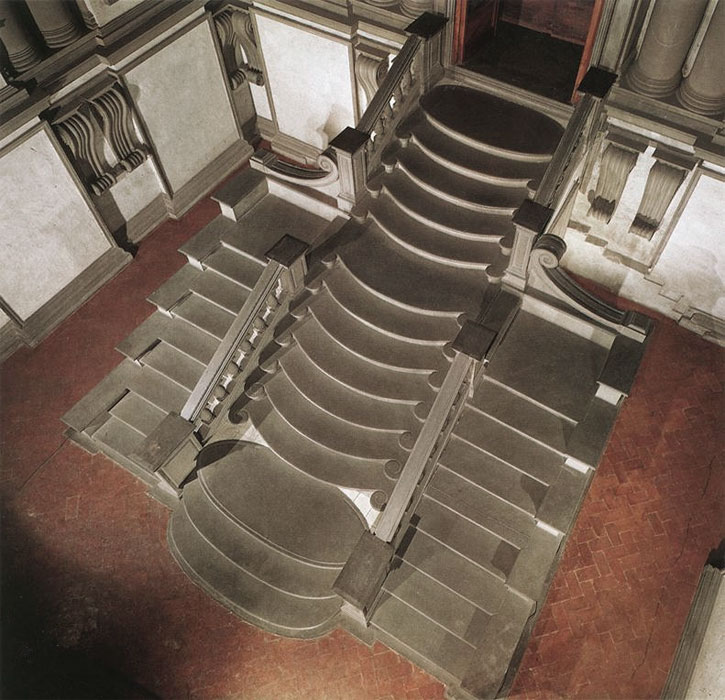
on the walls of the vestibule, downflows in the
fantastical staircase (built by Ammannati in 1559,
following a clay model prepared by Michelangelo).
It consists of three flights of steps; the outer
ones are quadrangular shaped, the central ones convex,
and the bottom three steps are completely elliptical.
The staircase is, then, an explosion of originality
which fits perfectly with the fanciful character
of the Mannerist style of architecture. The vertical
tensions of the vestibule seem to quieten down in
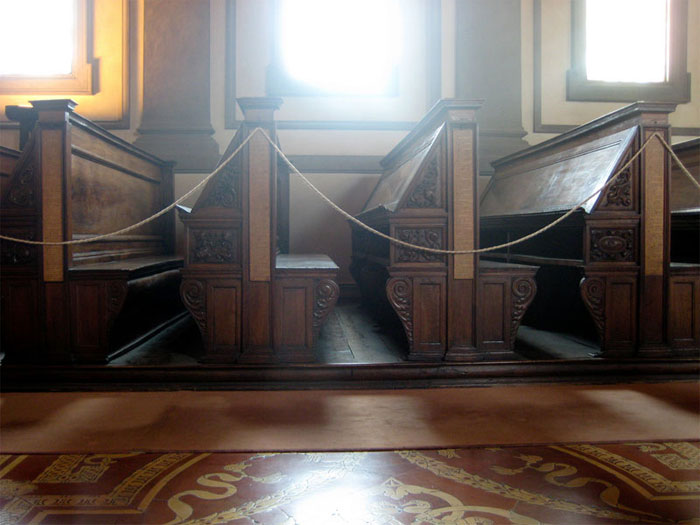
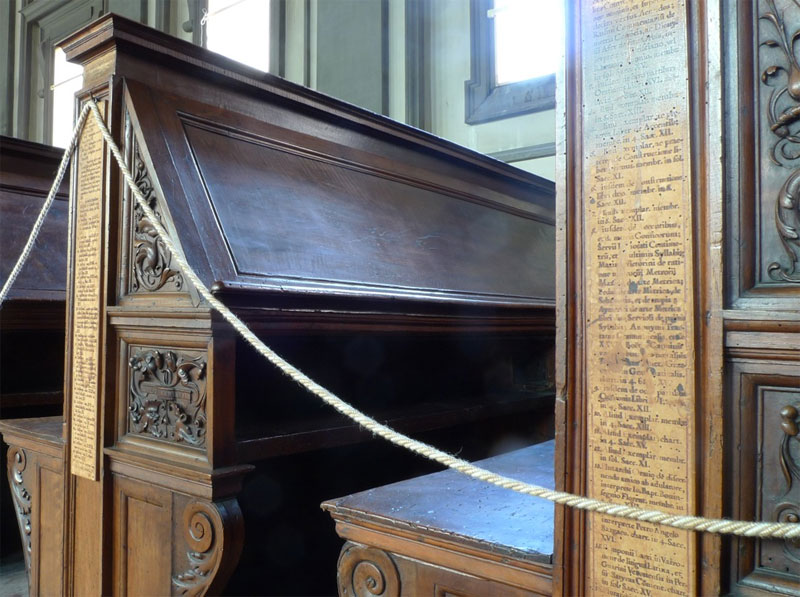
the long hall of the big reading-room. Here the guiding
principle of the design is the maximum use made of
the lateral sources of light.

|